 Norma
Norma
Norma › Legislation
Turkish legislation tracking and search
Which article changed and when, who cites it, what appeared in today's Official Gazette that concerns you — on a single screen.
In most organisations legislation tracking is still manual: someone checks the Official Gazette each morning and forwards whatever looks relevant. That method leaks in two places — nobody checks while that person is away, and “looks relevant” means something different to everyone.
Norma moves the job into the system. When the Official Gazette is published it is scanned automatically; if a document you follow has changed, an email and an in-app notification go out. What changed decides, not who happened to look.
Search operators
- Space
- Words are matched by their stems, side by side:
işçi ücretalso finds “işçinin ücreti”. - Quotes
"haklı nedenle fesih"— this exact phrase, no stemming applied.- Plus
kıdem+ihbar— documents containing both.- Comma
istifa, fesih— either one is enough.- Minus
tazminat -kıdem— excludes documents mentioning the second term.
A stemming engine built for Turkish
- Inflection tolerance
- Searching “işçi” also finds işçiler, işçinin, işçiye. It is dictionary-based rather than truncation-based, so unrelated words are not conflated.
- The Turkish dotted-I problem
- The distinction between İ/i and I/ı breaks most search engines on Turkish text. Norma handles it with its own folding rules.
Repealed provisions stay separate
- Marked apart
- Repealed documents and articles are shown separately; they never mix with the ones in force.
- Still reachable
- If you deliberately need a repealed provision — which rule applied to an older dispute — you can reach it. Its status is simply stated clearly.
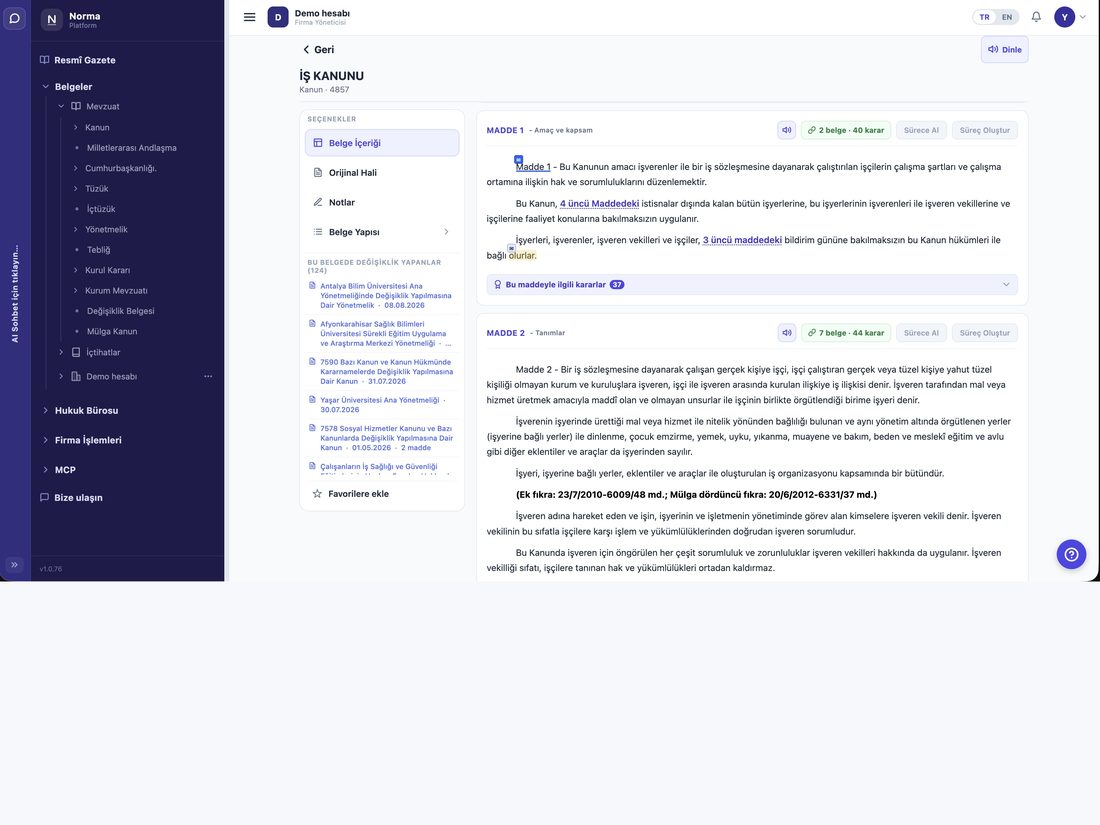
Article history and the citation network
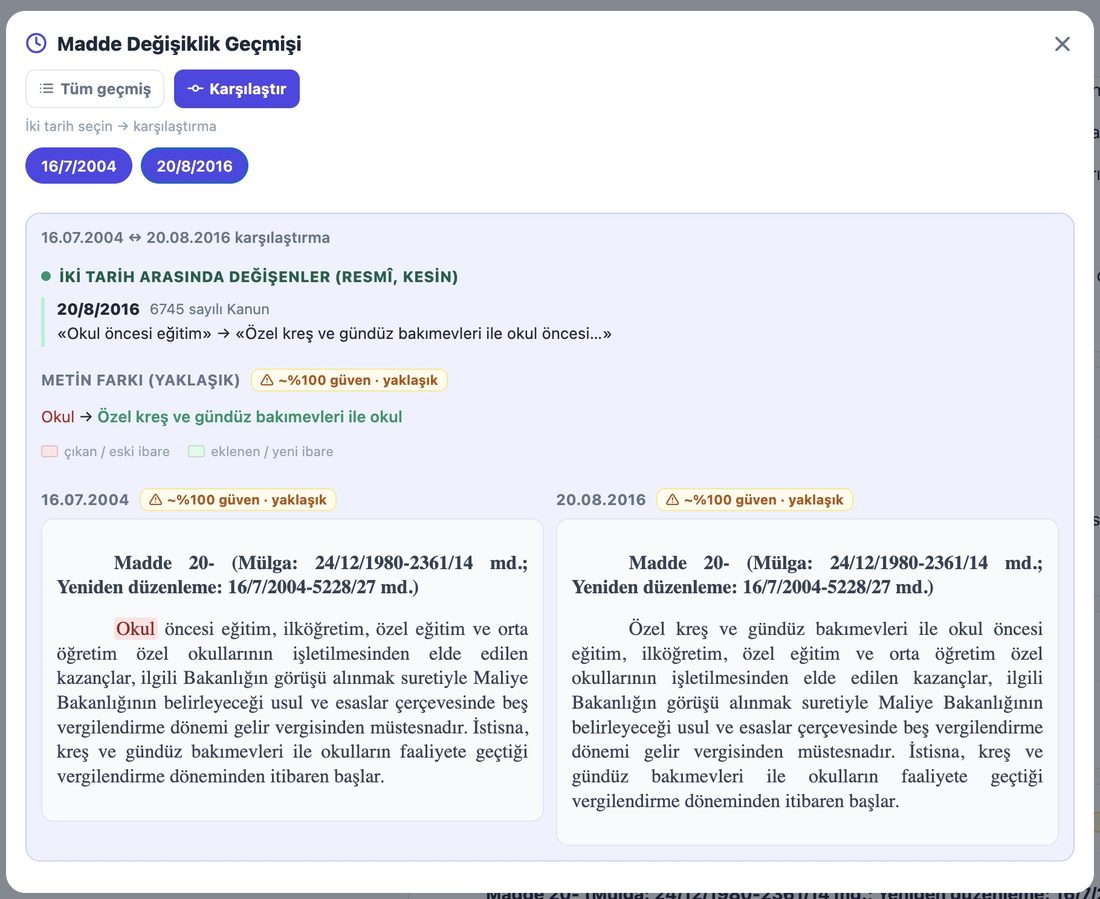
- Article history
- How an article changed over time: by which law, when, what was added or removed.
- Who cites this
- A query such as
4857 madde 17 atıf yapanlarlists both the legislation and the court decisions citing that article. - In-text links
- References inside the text are clickable and take you straight to the cited article.
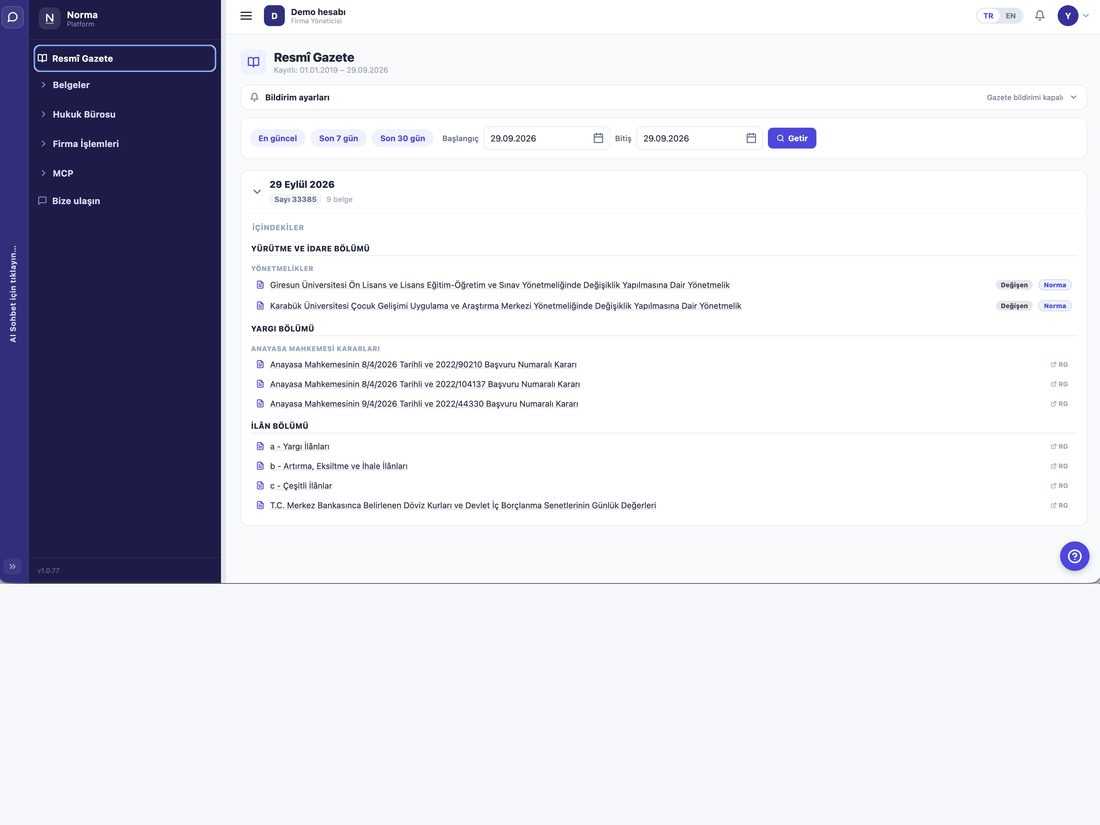
Official Gazette tracking
- Daily automated scan
- The Gazette is scanned on publication and newly published legislation enters the corpus.
- Three badges
- New · Amended · Repealed — what each record is, at a glance.
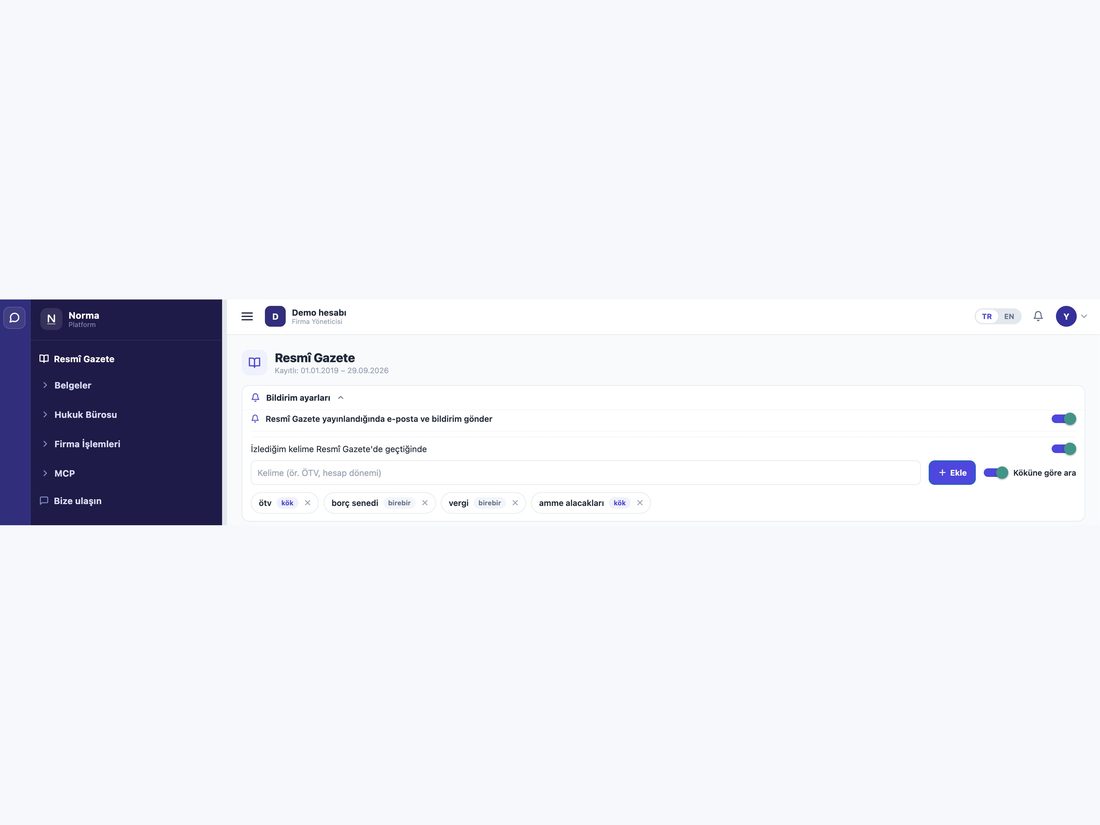
- Keyword watch
- If your chosen keywords appear in the Gazette you are notified. Useful for sector-specific terminology.
- Date range
- Last 7 days, last 30 days, or a range you pick.
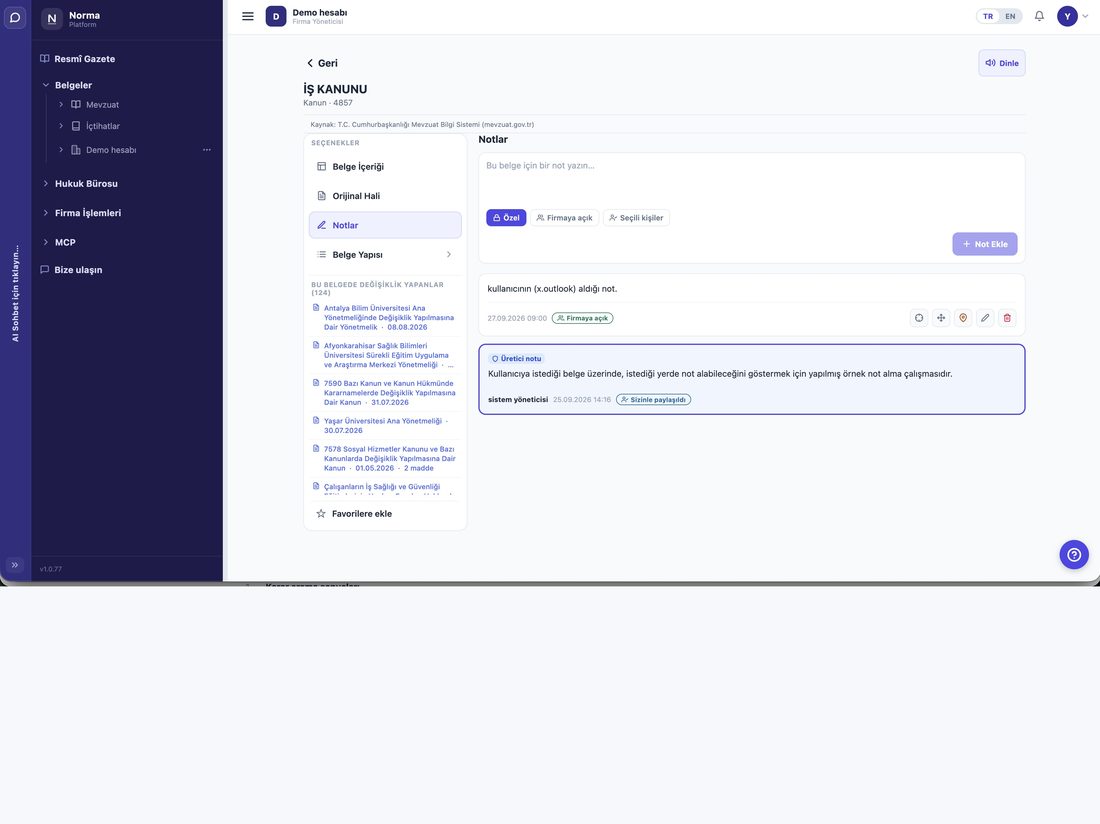
Notes — pinned to the exact spot
- Anchored where you select
- You leave a note on the passage you select, not on the document as a whole. Open the document again and the note is still exactly there.
- It notices when the text changes
- A digest of the anchored text is kept. If the provision changes and that sentence is reworded, the system knows — and shows the note at the top of the article instead of silently pinning it to the wrong place.
- Three sharing levels
- Only you · the whole firm (read-only) · specific people you pick.
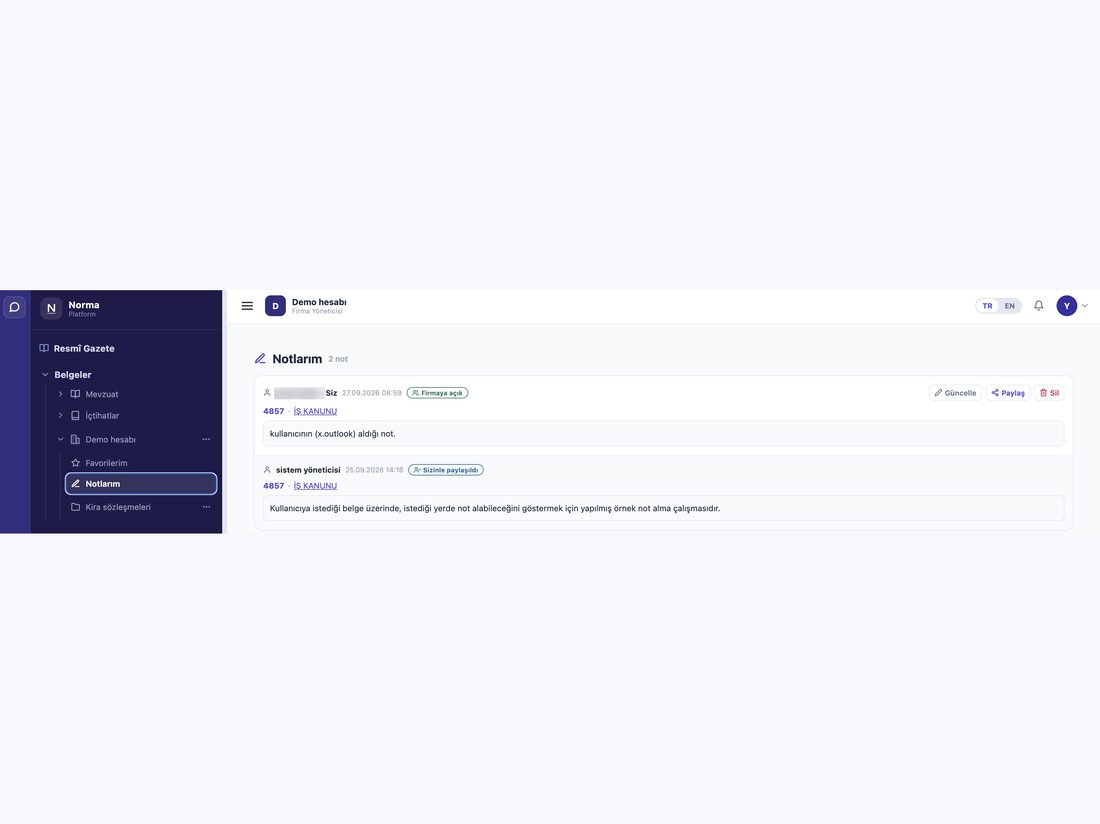
- A single list of your notes
- Every note you left, with the document and position it belongs to.
Notifications — news, not noise
- Batched into one
- If twenty documents you follow change on the same day you do not get twenty emails; they arrive as one.
- Never notified twice
- A re-scan does not re-announce a change already sent. The system records what was told to whom.
- Per-category switches
- You decide which kinds of notification you want.
- Mobile push
- Notifications reach your phone; you do not have to open the app.
Keyword watch — two modes
- Stem matching
vergialso catches vergisi, vergiler, vergiden — every inflected form of the term.- Exact matching
- Turn stemming off and watch only the literal word — useful for an institution name or a specific term.
- Where it looks
- Both the Gazette index and inside the documents the Gazette links to.
- Highlighted in the email
- The notification shows the sentence with the match highlighted, so you can judge relevance without opening the document.
Filters and organisation
- Type
- Law · Presidential decision · Regulation · Communiqué · Circular · Board decision · Decree-law and others.
- Authority
- The issuing body. Two fields are kept: the authority at the time of publication and today's successor — so historical accuracy survives institutional mergers.
- Favourites and notes
- Flag documents you return to; attach your own notes to an article.
- Original form
- The source text sits alongside the converted version, so you can always check the original.
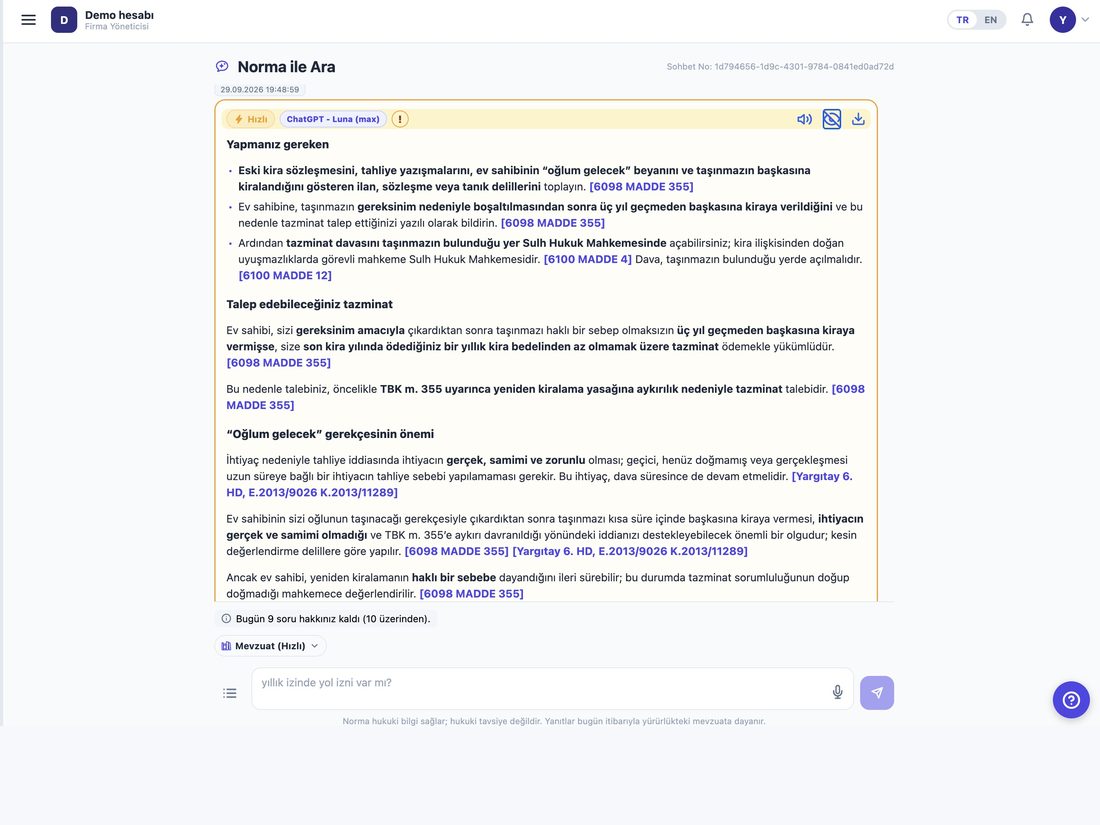
Product screens
Screenshots from a demo account running on real data.
Who uses it?
- Compliance and regulatory teams
- Track the legislation that affects your sector and hear about changes first.
- In-house counsel and law firms
- See an article's current wording, its history and the decisions citing it in one place.
- Foreign companies operating in Turkey
- Follow Turkish regulation without reading the Gazette every morning; the interface is fully available in English.
- Auditors and financial advisers
- Changes to tax and accounting communiqués are caught automatically.
Frequently asked questions
How often is the legislation updated?
The Official Gazette is scanned on every publication. If a document you follow has changed, you are notified the same day.
Which types of legislation are covered?
Laws, presidential decisions, regulations, communiqués, circulars, board decisions and decree-laws. Repealed provisions are marked separately.
Do I have to type the exact word form?
No. The stemming engine tolerates Turkish inflection. Use quotes if you need an exact phrase match.
Can I see an older version of an article?
Yes. Article history shows the changes over time, together with the law that made each change.